2021. Initializing... OK.
It’s a new year which means it's as good a time as any to reboot this blog.
In recent years I’ve been too caught up with the idea that everything I do here needs to be interesting and original. Back in 2011 when I started this blog it was relatively easy to write something original, but nowadays there are so many great resources online that I worry anything I write will offer little value.
At the name “The Project Spot” would imply I originally intended it to be a place I could document projects and express my thoughts on technology and entrepreneurship. But when I realised people were actually reading the content here I started to feel more of a sense of responsibility not to waste anyone’s time with personal posts or low quality content.
At some point I would like to get back to the roots of why I started this blog and post about things I’m thinking about and working on again...
As a brief update I’m still interested in startups, but I’m no long interested in trying to bootstrap my own projects. Post-2010 I found it increasingly hard to build something that was useful and unique as a solo founder. Around 2014 I decided I needed to take a break because at that point I had been working on projects nonstop for about 6 years and I was feeling extremely burnt out.
The truth is technology startups are really hard. They take months, if not years to build and even longer to scale. Most of the time they fail and when they do succeed most of the time they don’t end up generating enough income to warrant quitting your day job anyway.
A friend of mine recently sent me a link to an Indie Hackers post about how hard it is to start a tech company. For those unaware Indie Hackers is a community full of smart, talented people who are trying to build tech products – so perhaps it’s a little surprising to hear that so few of them are successful.
At some point I’m sure I’ll start posting here again, but for now I’ll leave it at that.
Thanks for reading.
An interview with Saf from Helpfulpeeps
Over the coming year I'm planning to conduct a series of interviews with local startups around the Bristol and Bath area. This week I was very happy to speak with Saf from the Bristol based startup, Helpfulpeeps.
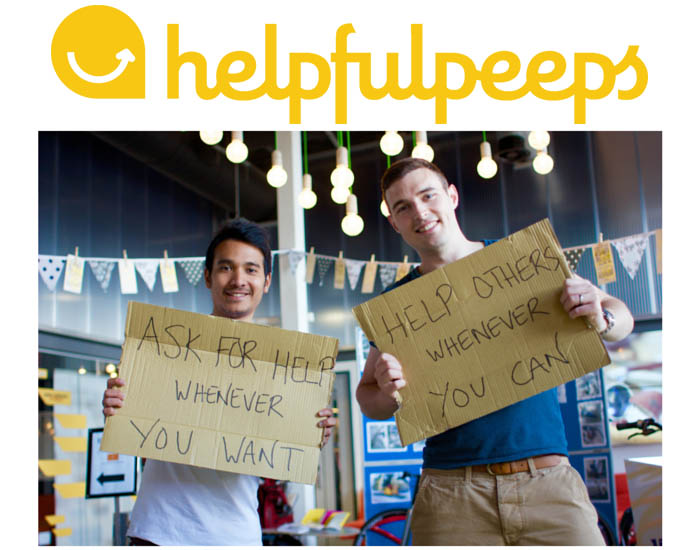
Helpfulpeeps is a new social network built on the principles of ‘paying it forward’ where people share their time, skills and knowledge to help each other for free. Each time you help, you earn karma which acts as your social capital on the platform. We call it the Karma Economy! We are on a mission to bring back community spirit in an increasingly disconnected world.
The idea came about as I looked to address some of the challenges we were facing as a society. The first was that it’s becoming increasingly apparent that there’s a lack of a sense of community in most cities these days. Secondly, I also felt that as a society we were becoming too focused on money, to the extent that that we were starting to measure value purely in terms of financial currency. I wanted to highlight the value of ‘human capital’, our time and energy because every individual has something to offer to each other and society at large based on their skills and passions. So this led to the initial idea for Helpfulpeeps as a website where members can ask for help and repay to the whole rather than the individual and can trust that when they need help the community will provide it.
I think that is always going to be a challenge but we found that the early users who joined Helpfulpeeps were doing so because they believed in the concept and our mission and they actually helped us spread the word by inviting people to join through word of mouth. Where we lacked a critical mass of users in the beginning we more than made up for in enthusiasm of early users as we got daily emails from members asking how much they loved the concept and if there was anything they could do to help us grow the community. In terms of cities we’ve been primarily focused on Bristol as we recognised that in order for Helpfulpeeps to be truly useful we needed to build up some kind of critical mass in a given location. However we recently launched into Bath and the uptake has been fantastic.
In terms of recent examples that come to mind the Helpfulpeeps community got together and donated over 100 gifts for disadvantaged kids in times for Christmas and this was off the back of one post from one lady who proposed the idea as she had worked in social services and knew how to get the gifts to the right people.
Having said that we’ve had over 1200 requests posted, which have been met by over 900 offers of help so there’s been many interesting ways in which people have helped each other in the community. Some recent examples include help with changing a car battery, teaching guitar, help building a wordpress site, volunteering for a mock interview day at a school just to name a few.
I’ve learnt many lessons in the last couple of years but the biggest one for me so far has been patience and persistence. I’ve never been great at being patient so that’s been particularly challenging but I’m starting to realise that it takes time to build anything meaningful and that the reward is directly linked to the amount of challenges you’ve overcome.
The only advice that I can give is to make sure you start a company for the right reasons - i.e. you're passionate about solving the problem. Ask yourself would you work on this if there was no financial incentive? Because if you’re just in it for the money chances are you’ll give up when the going gets tough (and it’s definitely going to get tough both psychologically and financially). The statistical likelihood is that your startup is going to fail. So to paraphrase Elon Musk - is it important enough for you to try - even if the most likely outcome is failure? If you answer yes then you are on the right track.
We have huge ambitions for 2017 where we hope to take Helpfulpeeps from 10k to 100k+ members and to launch in multiple cities across the UK. We want to be part of the narrative when it comes to removing the stigma around asking for help. We also want to encourage more people to volunteer and get involved in their communities.
Ant Colony Optimization For Hackers
Originally proposed in 1992 by Marco Dorigo, ant colony optimization (ACO) is an optimization technique inspired by the path finding behaviour of ants searching for food. ACO is also a subset of swarm intelligence - a problem solving technique using decentralized, collective behaviour, to derive artificial intelligence.
Recent Tutorials
Ant Colony Optimization For Hackers
Originally proposed in 1992 by Marco Dorigo, ant colony optimization (ACO) is an optimization technique inspired by the path finding behaviour of ants searching for food. ACO is also a subset of swarm intelligence - a problem solving technique using decentralized, collective behaviour, to derive artificial intelligence.
Continue Reading...Solving the Traveling Salesman Problem Using Google Maps and Genetic Algorithms
An ideal way to explore the potential of genetic algorithms is by applying them to real world data. Perhaps one of the easiest ways to do this is by using the Google Maps API to implement a solution to the traveling salesman problem.
Continue Reading...